
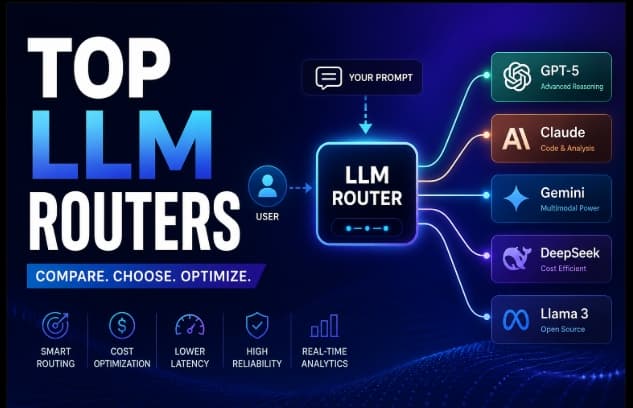
Top LLM Routers and How to Select the Right One
Every AI task doesn't need the same language model. A simple customer support question, a coding request, and a complex reasoning task all have different performance, latency, and pricing requirements. Sending every prompt to one model often leads to higher costs and inconsistent results.
An LLM router solves this by using intelligent model selection and dynamic routing to send each request to the AI model best suited for the task. The result is better performance, improved cost optimization, and greater reliability. This guide explains how an LLM router works, compares the leading platforms, and highlights the features to consider when choosing the right solution for your AI application.
What Is an LLM Router?

An LLM router is software that analyzes an incoming prompt and sends it to the most appropriate language model. Rather than forwarding every request to the same provider, the router evaluates predefined rules, performance metrics, or prompt characteristics before selecting a destination.
For example, a customer support chatbot might send simple questions to a low-cost model while directing technical troubleshooting requests to a more advanced reasoning model. This approach improves efficiency without sacrificing response quality.
Most routing platforms support multiple providers through asingle API. This allows developers to switch between models without changing application logic or maintaining separate integrations for each provider.
How an LLM Router Works
A typical routing process follows these steps:
- Your application sends a prompt to the routing layer.
- The router evaluates the request using routing rules, prompt classification, latency, pricing, or availability.
- The router chooses the best language model for the task.
- The selected provider generates a response.
- The response is returned to your application through the same interface.
This process happens in milliseconds, allowing applications to balance performance, reliability, and operating costs without adding complexity to the user experience.
Why LLM Routing Matters
As businesses adopt multiple AI providers, managing them individually becomes difficult. Different providers have different APIs, pricing structures, response times, and availability. An effective routing layer simplifies this complexity while improving application reliability.
The main benefits include:
- Better response quality by matching requests with the most suitable model.
- Lower infrastructure spending through intelligent cost optimization.
- Higher availability with automatic failover when a provider becomes unavailable.
- Reduced latency by selecting faster models for time-sensitive requests.
- Easier scaling through a single integration that supports multiple providers.
- Greater flexibility to adopt new models without rebuilding existing applications.
Instead of treating every request the same, routing enables applications to make smarter decisions based on business priorities, whether the goal is accuracy, speed, reliability, or budget.
Top LLM Routers Compared
The number of routing platforms has grown rapidly as businesses move from using a single provider to managing multiple AI models. Some platforms focus on broad model access, while others prioritize governance, analytics, or enterprise security. The best choice depends on your application, budget, and operational requirements.
| LLM Router | Best For | Standout Feature |
|---|---|---|
| Tokenware | Production AI applications | Intelligent routing with unified AI infrastructure |
| OpenRouter | Model experimentation | Access to hundreds of public models |
| Portkey | Enterprise deployments | Governance, observability, and security |
| LiteLLM | Open source projects | Unified API for multiple providers |
| Braintrust Gateway | AI observability | Performance monitoring and evaluations |
| Cloudflare AI Gateway | Cloud-native applications | Security and traffic management |
| Kong AI Gateway | Enterprise API management | Policy enforcement and authentication |
| Helicone | Monitoring AI usage | Cost tracking and analytics |
Tokenware
Tokenware is a production-focused LLM router designed for businesses managing multiple AI providers. The platform provides access to 119 AI models through a single API and combines dynamic routing, analytics, fallback handling, and unified billing in one interface.
Its biggest advantage is intelligent model selection. Instead of sending every request to the same provider, Tokenware evaluates latency, availability, pricing, and business rules before choosing the best model. This helps teams improve reliability while supporting cost optimization at scale.
Best for: SaaS platforms, AI agents, enterprise applications, and production AI workloads. * Pros*
- Access to 119 AI models through one API
- Strong dynamic routing capabilities
- Built-in analytics and monitoring
- Automatic failover between providers
- OpenAI-compatible integration
- Unified billing across providers
Cons
- Advanced routing features may be unnecessary for small projects
- Enterprise-focused capabilities can increase implementation complexity
OpenRouter
OpenRouter gives developers access to 447 AI models through a unified API. It is widely used for experimentation and benchmarking because switching between providers requires minimal configuration.
Best for: Prototyping, AI experimentation, and research.
Pros
- Access to 447 AI models
- Simple setup process
- Easy provider switching
- Good for benchmarking AI models
Cons
- Limited enterprise governance features
- Basic monitoring compared with production-focused platforms
Portkey
Portkey is built for enterprise AI operations and combines routing with governance, observability, caching, security controls, and usage analytics. Large organizations often choose Portkey because it provides detailed request tracing and operational visibility across development and production environments.
Best for: Enterprise deployments and regulated industries.
Pros
- Advanced logging and tracing
- Strong security and compliance controls
- Built-in caching support
- Detailed usage analytics
Cons
- More complex than lightweight routing solutions
- May be overkill for small teams
LiteLLM
LiteLLM is one of the largest routing ecosystems available, supporting approximately 2,940 AI models across multiple providers. Its open source architecture gives developers full control over deployment and customization.
Best for: Open source projects and self-hosted deployments.
Pros
- Access to approximately 2,940 AI models
- Open source and highly customizable
- Supports many providers
- Strong developer community
Cons
- Requires more operational management
- Enterprise features depend on additional tooling
Braintrust Gateway
Braintrust Gateway focuses on observability and evaluation workflows while supporting 16 AI models. It helps engineering teams compare provider performance and improve routing decisions using real usage data.
Best for: AI engineering teams and performance monitoring.
Pros
- Comprehensive request tracing
- Strong performance analytics
- Built-in evaluation tools
- Focused observability capabilities
Cons
- Supports fewer AI models than broader routing platforms
- Primarily focused on observability use cases
Cloudflare AI Gateway
Cloudflare AI Gateway extends Cloudflare's network infrastructure into AI workloads. It adds logging, caching, rate limiting, and traffic management for applications already running on Cloudflare.
Best for: Cloud-native applications and edge deployments.
Pros
- Excellent traffic management
- Built-in caching and rate limiting
- Strong integration with Cloudflare services
Cons
- Less focused on advanced routing logic
- Best suited to Cloudflare-based infrastructure
Kong AI Gateway
Kong AI Gateway brings AI traffic under the same governance framework used for traditional APIs. It emphasizes authentication, policy enforcement, and centralized management.
Best for: Security-focused enterprise environments.
Pros
- Strong authentication controls
- Centralized policy management
- Enterprise-grade security
Cons
- Advanced configuration may require experienced administrators
- Less focused on intelligent model selection
Helicone
Helicone focuses on monitoring AI applications and currently supports 111 AI models. It tracks latency, token usage, and provider performance to help teams identify opportunities for cost optimization.
Best for: AI monitoring and usage analytics.
Pros
- Support for 111 AI models
- Detailed cost tracking
- Performance monitoring
- Useful operational dashboards
Cons
- Limited routing capabilities compared with dedicated routers
- Best used alongside other routing infrastructure
Features to Look for in an LLM Router
 Not every routing platform offers the same capabilities. Some focus on connecting multiple providers through one API, while others include advanced controls for performance, security, and monitoring. Before choosing a solution, evaluate the features below.
Support for Multiple AI Models
A good router should work with leading providers through a single integration. This gives your team the flexibility to adopt new models or replace existing ones without changing application code.
Intelligent Prompt Routing
The platform should direct requests based on predefined rules or real-time conditions such as prompt complexity, response time, provider availability, or budget. This approach helps deliver consistent results without manual intervention.
Automatic Failover
Provider outages happen. Automatic failover keeps applications running by redirecting requests to another available provider when the primary one is unavailable or exceeds latency thresholds.
Cost Optimization
AI usage grows quickly as applications scale. Look for features that reduce unnecessary spending, such as sending simple requests to lower-cost models, setting usage limits, and tracking token consumption across providers.
Performance Monitoring
Built-in analytics help engineering teams monitor latency, success rates, token usage, and request volume. These insights make it easier to identify bottlenecks and improve application performance over time.
Security and Access Controls
Enterprise applications often require API key management, authentication, request logging, and role-based permissions. Strong security features help protect sensitive data and simplify compliance.
OpenAI-Compatible API
Many applications already use the OpenAI API format. Choosing a router with an OpenAI-compatible interface reduces migration effort and speeds up integration with existing applications.
Scalability
As traffic increases, your routing platform should continue handling requests efficiently without requiring major infrastructure changes. Support for load balancing, caching, and high request volumes becomes increasingly important for production deployments.
How to Choose the Right LLM Router
The best routing platform depends on how your organization uses AI. If you're building an MVP or testing different AI models, prioritize ease of integration and broad provider support. Open source solutions and platforms with unified APIs often provide the fastest path to deployment.
For production applications, focus on reliability, intelligent model selection, monitoring, and automatic failover. These features become increasingly valuable as request volumes grow.
Enterprise organizations should also evaluate governance, compliance, security controls, and detailed analytics. Managing AI infrastructure across multiple teams requires more than basic request routing.
Finally, consider long-term scalability. The AI ecosystem evolves rapidly, with new providers and models released throughout the year. Choosing a routing platform that regularly expands provider support and improves routing capabilities will reduce migration work as your application grows.
LLM Router vs AI Gateway
 The terms "LLM router" and "AI gateway" are often used interchangeably, but they serve different purposes. A router focuses on deciding which language model should handle a request, while a gateway manages and secures traffic between your application and AI providers.
Many modern platforms combine both capabilities, giving developers a single solution for routing, authentication, monitoring, and usage management.
| Feature | LLM Router | AI Gateway |
|---|---|---|
| Primary purpose | Directs prompts to the best language model | Manages AI API traffic |
| Decision making | Chooses models based on rules, performance, or request characteristics | Applies security, governance, and traffic policies |
| Provider failover | Yes | Often supported |
| Authentication | Basic or platform-dependent | Core feature |
| Usage analytics | Usually included | Usually included |
| Rate limiting | Sometimes | Yes |
| Best for | Improving response quality, model selection, and cost optimization | Securing and managing AI infrastructure |
If your goal is to improve application performance by using different language models, a router is the right starting point. If you need centralized authentication, security policies, request logging, and governance across multiple AI services, an AI gateway provides those capabilities. Many organizations choose a platform that combines both functions to reduce operational complexity.
Common Mistakes When Choosing an LLM Router
Selecting the wrong platform can lead to higher costs, poor performance, and unnecessary engineering work. Avoid these common mistakes.
Choosing Based Only on Price
A lower monthly cost does not always result in lower operating expenses. Consider reliability, scalability, and included features before making a decision.
Ignoring Provider Failover
Service interruptions are inevitable. Without automatic failover, applications risk downtime whenever a provider experiences an outage or performance issues.
Overlooking Analytics
Monitoring token usage, latency, and request success rates helps identify performance issues and control spending. A platform with limited visibility makes optimization much harder.
Not Planning for Growth
A solution that works during development may struggle under production traffic. Consider throughput limits, supported providers, and scaling capabilities before deployment.
Focusing Only on Today's Requirements
AI evolves quickly. Choose a platform that regularly adds new providers and models so your application remains flexible as the ecosystem changes.
Conclusion
As organizations continue adopting multiple AI models, choosing the right routing platform has become an important architectural decision. An effective LLM router improves response quality through intelligent model selection, enables dynamic routing based on business requirements, and delivers meaningful cost optimization as AI workloads scale.
When comparing solutions, don't focus only on the number of supported providers. Evaluate how well the platform performs model selection, supports dynamic routing, handles failover, provides analytics, and integrates with your existing infrastructure. If your organization also needs centralized security and traffic management, choose a platform that combines routing capabilities with an AI gateway.
The best LLM router is the one that balances performance, flexibility, and operational efficiency while giving your team the freedom to adopt new AI models as the AI ecosystem continues to evolve.
Frequently Asked Questions
1.What factors influence model selection?
The most common factors include prompt complexity, latency, token limits, response quality, pricing, provider availability, and business rules.
2. What is dynamic routing in AI?
Dynamic routing automatically evaluates each request and directs it to the most suitable model based on performance, cost, or predefined routing policies.
3. How does prompt classification improve routing?
Prompt classification identifies the intent of a request, such as coding, summarization, translation, or reasoning, before selecting the most appropriate model.
4. Can multiple AI models be used in one application?
Yes. Many AI applications use different models for different workloads to improve performance, reduce costs, and increase reliability.
5. What is the difference between rule-based and intelligent routing?
Rule-based routing follows predefined conditions, while intelligent routing uses performance metrics or machine learning to make routing decisions automatically.
6. Does an AI gateway improve security?
Yes. An AI gateway centralizes authentication, API key management, rate limiting, logging, and access control across multiple AI providers.
7. What is semantic caching?
Semantic caching stores responses to similar prompts so repeated requests are served faster without generating a new response each time.
8. How is latency measured in AI inference?
Latency measures the time between sending a request and receiving a response. Lower latency improves the user experience for real-time applications.
9. Can routing reduce inference costs?
Yes. Directing routine requests to lower-cost models while reserving premium models for complex tasks is one of the most effective cost optimization strategies.
10. Why is provider failover important?
Automatic failover maintains application availability by redirecting requests to another provider when the preferred model becomes unavailable or experiences performance issues.