
What is Model Routing, and How does it work?
Modern AI applications often use multiple AI models instead of relying on a single one. A coding assistant, for example, might use one model for code generation, another for document analysis, and a third for customer support. Choosing the right model for each request is known as Model Routing.
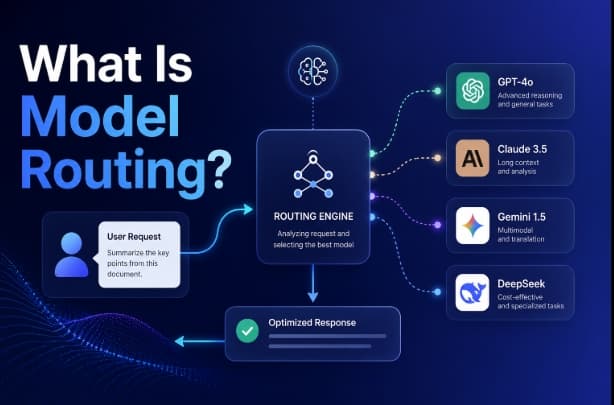
Model Routing automatically analyzes a request and sends it to the AI model best suited for the task. By considering factors such as prompt complexity, inference cost, latency, context window, and model availability, it helps improve response quality while reducing costs and improving reliability.
As businesses adopt more AI models, model routing has become a critical part of modern AI infrastructure. Platforms like Tokenware combine intelligent model routing with an AI gateway, allowing developers to connect to multiple AI providers through a single API and automatically route requests to the most appropriate model.
What Is Model Routing?
 Model Routing is the process of automatically selecting the best AI model for each request based on factors such as task type, latency, inference cost, context window, and model availability.
Instead of sending every request to the same model, a routing engine evaluates the prompt and directs it to the model best suited for the task. This improves response quality, reduces costs, and optimizes AI performance.
Example of Model Routing
| User Request | Selected Model | Reason |
|---|---|---|
| Summarize meeting notes | Small language model | Lower inference cost and fast response |
| Generate Python code | Coding model | Optimized for software development |
| Analyze a legal agreement | Advanced reasoning model | Better analytical performance |
| Translate a document | Multilingual model | Improved translation accuracy |
| Generate a product image | Vision model | Built for image generation |
Without Model Routing, every request would go to the same model regardless of its complexity. This increases costs and often delivers inconsistent performance.
What Does an AI Router Do?
An AI router is the component responsible for making routing decisions. It sits between the user and the available models, analyzes each request, and forwards it to the most appropriate destination.
Its responsibilities often include:
- Evaluating the complexity of a prompt
- Identifying the type of task, such as writing, coding, translation, or summarization
- Checking latency and performance requirements
- Considering cost limits
- Applying business rules or security policies
- Selecting the best available model
- Falling back to another model if one becomes unavailab
le
This decision usually happens within milliseconds, creating a seamless experience for the end user.
           User Request
                │
                ▼
          +-------------+
          |  AI Router  |
          +-------------+
                │
 ┌──────────────┼──────────────┐
 ▼              ▼              ▼
Writing Model Coding Model Vision Model
How Model Routing Differs From an AI Gateway
 Many people confuse Model Routing with an AI Gateway because both sit between users and AI services. While they work together, they serve different purposes.
| Model Routing | AI Gateway |
|---|---|
| Chooses the best model for each request | Manages and secures AI API traffic |
| Focuses on quality, cost, and performance | Focuses on authentication, logging, rate limiting, and monitoring |
| Makes routing decisions | Handles request management and governance |
| Optimizes model selection | Simplifies access to multiple AI providers |
In many production systems, an AI Gateway includes routing capabilities, but not every gateway performs intelligent routing. Some simply forward requests without evaluating which model is the best fit. For example, Tokenware provides a unified AI Gateway that simplifies access to multiple providers while using intelligent Model Routing to optimize performance, reduce costs, and improve reliability. Instead of maintaining separate integrations for each provider, developers work with a single API while Tokenware manages request routing behind the scenes.
How Does Model Routing Work?
 Every request sent to an AI application goes through a decision process before reaching a model. Rather than sending every prompt to the same model, Model Routing evaluates the request and selects the AI model most likely to deliver the best result while meeting performance and cost requirements.
Whether you're building a chatbot, AI search tool, or enterprise application, the routing process typically follows the same workflow.
Every request sent to an AI application goes through a decision process before reaching a model. Rather than sending every prompt to the same model, Model Routing evaluates the request and selects the AI model most likely to deliver the best result while meeting performance and cost requirements.
Whether you're building a chatbot, AI search tool, or enterprise application, the routing process typically follows the same workflow.
            User Prompt
                 │
                 ▼
         Request Analysis
                 │
                 ▼
        Routing Decision Engine
                 │
 ┌───────────────┼────────────────┐
 ▼               ▼                ▼
GPT-5 Claude Sonnet Gemini 2.5
 │               │                │
 └───────────────┼────────────────┘
                 ▼
          Response Returned
If you're using Tokenware, this workflow happens automatically through a single API. Developers configure routing policies once, and Tokenware handles model selection, provider failover, and request routing behind the scenes.
Step 1: Receive the Request
The routing process begins when a user submits a prompt through a chatbot, application, or API.
Examples include:
- Summarise this meeting transcript.
- Write a Python function.
- Explain this financial report.
- Translate this document into Spanish.
- Generate an image for a product launch.
At this stage, no model has been selected. The system simply receives the request and prepares it for analysis.
Step 2: Analyze the Request
The routing engine analyzes the request to determine the best AI model for the task. It considers factors such as the task type, prompt complexity, context window, latency requirements, inference cost, model availability, and any business rules or compliance requirements.
For example, summarising meeting notes requires far less processing than analysing a legal contract. Instead of sending both requests to the same model, Model Routing selects the option that provides the best balance of quality, speed, and cost.
Step 3: Select the Best Model
After analyzing the request, the routing engine selects the AI model that best matches the workload. A coding request might be routed to a coding model, while a document translation request is sent to a multilingual model. More complex reasoning tasks are typically directed to advanced reasoning models.
This selection happens in milliseconds, allowing users to receive the best response without manually choosing a model.
Step 4: Process the Request and Return the Response
The selected model processes the prompt and returns the response to the application. If the preferred provider is unavailable or reaches its rate limit, many routing systems automatically redirect the request to another compatible model. This fallback capability improves reliability without interrupting the user experience.
From the user's perspective, every interaction feels like a conversation with a single AI assistant. Behind the scenes, the routing engine has already analyzed the request, selected the most suitable model, and delivered the response.
Types of Model Routing
Different applications require different routing strategies. The right approach depends on workload, budget, response time requirements, and business goals. The most common routing strategies include the following.
Rule-Based Routing
Rule-based routing uses predefined conditions to determine which model should handle a request. For example:
IF request contains code
→ Route to coding model
IF prompt exceeds 100,000 tokens
→ Route to long-context model
ELSE
→ Route to general-purpose model
This approach is simple to implement and works well for predictable workloads, such as internal business tools or customer support systems.
Dynamic Routing
Dynamic routing evaluates each request in real time instead of following predefined rules. It considers factors such as prompt complexity, latency, inference cost, model performance, and availability before selecting the most suitable AI model.
Because routing decisions adapt to changing workloads and provider performance, dynamic routing is the preferred approach for most enterprise AI applications.
Cost-Aware Routing
Cost-aware routing reduces AI spending by sending simple requests to lower-cost models while reserving advanced models for tasks that require stronger reasoning. This helps organizations optimize inference costs without sacrificing response quality.
Hybrid Routing
Hybrid routing combines multiple routing strategies into a single decision process. It evaluates factors such as business rules, prompt complexity, latency, inference cost, and model availability before selecting the best AI models. This approach offers the best balance of performance, reliability, and cost for production AI applications.
Platforms like Tokenware support configurable hybrid routing, allowing organizations to optimize requests based on their business priorities.
Static vs. Dynamic Routing
Static routing uses predefined rules, while dynamic routing evaluates each request in real time. Although static routing works well for simple applications, dynamic routing is better suited for production AI systems because it adapts to changing workloads, pricing, and model performance.
When Should You Use Model Routing?
Model Routing is most valuable when an application uses multiple AI models or needs to balance response quality, latency, and cost. You should consider using Model Routing if your application:
- Uses multiple AI models or providers.
- Handles different tasks, such as coding, document analysis, translation, or content generation.
- Needs to reduce inference costs.
- Requires low-latency responses.
- Needs automatic failover if a provider becomes unavailable.
- Processes high volumes of AI requests.
If your application relies on a single model with predictable workloads, Model Routing is usually unnecessary. As AI applications grow, intelligent routing becomes an important part of building scalable and cost-effective AI systems.
How to Choose the Right AI Model for Routing
The best AI model depends on the task, not the application. Simple requests perform well on smaller, faster models, while coding, reasoning, or long-document analysis often require more capable models. Choose models based on the quality, speed, and cost required for each request. Model Routing automates this process, ensuring every prompt is handled by the most appropriate model.
Model Routing vs. Load Balancing
Although both direct requests, they serve different purposes. Load balancing distributes traffic across servers to improve availability, while model routing analyzes each request and selects the AI model best suited for the task. Many production AI systems use both together, with load balancing managing infrastructure and model routing optimising model selection.
Model Routing vs. AI Orchestration
Model routing selects the best AI model for a request, while AI orchestration manages the entire AI workflow. For example, an orchestration pipeline might extract text from a document, route it to an LLM, store the output, and trigger another application. Model Routing is one step within that workflow.
Benefits of Model Routing
Model Routing helps organizations build faster, more reliable, and cost-effective
AI applications. Its main benefits include:
- Lower inference costs by routing simple requests to smaller models.
- Better response quality by matching tasks with specialized AI models.
- Lower latency for real-time applications.
- Higher reliability through automatic failover.
- Reduced vendor lock-in by supporting multiple AI providers.
- Easier scalability as new AI models become available.
How Tokenware Simplifies Model Routing
Managing multiple AI providers often means maintaining separate APIs, routing rules, monitoring, and fallback logic. Tokenware simplifies this through a unified AI Gateway that provides access to multiple AI models through a single API.
With Tokenware, you can:
- Route requests based on task type, cost, or latency.
- Configure custom routing policies.
- Automatically fail over to backup providers.
- Monitor token usage, latency, and costs from one dashboard.
- Scale multi-model AI applications without managing multiple integrations.
This allows development teams to focus on building AI features instead of maintaining AI infrastructure.
Best Practices for Model Routing
A well-designed routing strategy improves over time. As new AI models become available and business requirements change, organizations should regularly evaluate how requests are routed. Follow these best practices to get the most from Model Routing.
Start with Simple Routing Rules
Begin with straightforward routing based on task type or prompt complexity. As your application grows, introduce more advanced policies that consider latency, inference cost, and model performance.
Monitor Performance Continuously
Track metrics such as:
- Response quality
- Response time
- Token usage
- Inference cost
- Error rate
These insights help identify opportunities to improve routing decisions and reduce operating costs.
Configure Fallback Models
Production AI applications should never rely on a single provider. Configure backup models so that requests continue to be processed during outages, maintenance windows, or rate limits. Automatic failover improves reliability and creates a more consistent user experience.
Review Routing Policies Regularly
AI models continue to improve, pricing changes frequently, and new providers enter the market. Review routing policies periodically to ensure your application continues using the models that provide the best balance of quality, speed, and cost. Platforms like Tokenware make this process easier by centralizing model management, routing configuration, and usage analytics in one place.
Conclusion
Model Routing has become an essential part of building modern AI applications. Automatically selecting the best AI model for each request, it helps improve response quality, reduce inference costs, lower latency, and support multiple AI providers without adding unnecessary complexity. As more businesses adopt multi-model AI strategies, intelligent routing will play an increasingly important role in delivering scalable and cost-effective AI solutions.
With Tokenware, you can simplify model routing through a unified AI gateway, giving you a single API to connect multiple AI providers, optimize routing decisions, and manage your AI infrastructure more efficiently.
Frequently Asked Questions
1. Can Model Routing work with multiple AI providers?
Yes. Model Routing supports multiple AI providers by selecting the most appropriate model based on predefined rules or real-time conditions. This allows applications to switch between providers without changing the user experience.
2. Does Model Routing increase application latency?
No. Routing decisions typically take only a few milliseconds, making the impact on overall response time negligible.
3. Can Model Routing use custom business rules?
Yes. Organizations can create routing policies based on factors such as request type, budget, compliance requirements, user tier, or preferred AI provider.
4. How does Model Routing handle provider outages?
Most routing systems include failover mechanisms that automatically redirect requests to an alternative AI model or provider when the preferred option is unavailable.
5. Is Model Routing different from prompt routing?
Yes. Prompt routing classifies requests based on their content, while Model Routing uses additional factors such as latency, inference cost, model performance, and availability to select the best AI model.
6. What metrics should you monitor in a Model Routing system?
Key metrics include response latency, inference cost, token usage, request success rate, model accuracy, and provider availability.
7. Can Model Routing improve AI cost optimization?
Yes. It reduces unnecessary spending by sending simple requests to lower-cost models and reserving advanced models for more complex workloads.
8. Does Model Routing require an AI Gateway?
No. Model Routing can operate independently, but combining it with an AI Gateway simplifies provider management, authentication, monitoring, and centralized access to multiple AI models.