
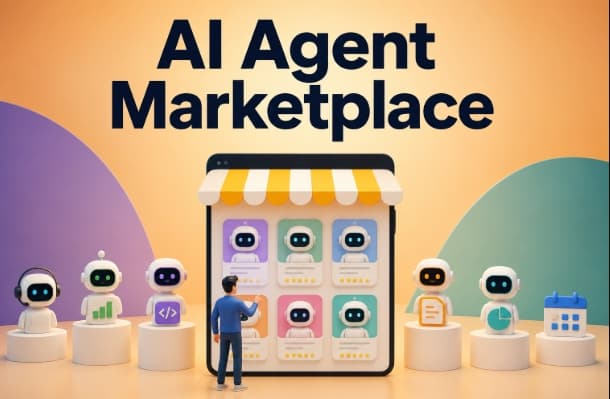
AI Agent Marketplace: Why Businesses Are Adopting Them
An AI agent marketplace is changing how businesses adopt artificial intelligence. Instead of building custom AI solutions for every task, organizations choose from ready-made agents that automate customer support, software development, sales, finance, HR, and other business functions. This approach reduces development time, lowers implementation costs, and helps teams deploy AI more quickly.
As these marketplaces continue to expand, businesses need more than access to specialized agents. They also need secure infrastructure to manage models, integrations, usage, and performance across multiple AI providers. Together, these capabilities make it easier to scale AI initiatives without increasing operational complexity.
What Is an AI Agent Marketplace?

An AI agent marketplace is a platform where businesses find, deploy, and manage pre-built AI agents designed to perform specific tasks. Instead of creating every solution from scratch, organizations choose agents that match their business needs, connect them to existing systems, and put them into production with minimal development.
Unlike a general AI model catalog, an AI agent marketplace offers complete solutions built for real business functions. Each listing typically includes the logic, integrations, and configuration needed to perform a specific job, such as resolving customer inquiries, reviewing documents, qualifying sales leads, generating code, processing invoices, or analyzing internal data.
Most marketplaces also provide tools for deployment, version management, permissions, analytics, and updates, making them suitable for teams that want to scale AI across multiple departments while maintaining operational control.
Common Types of Agents Available
- Customer support assistants
- Sales and lead qualification assistants
- Marketing and content assistants
- Software development assistants
- Finance and accounting assistants
- HR and recruiting assistants
- Document processing assistants
- Internal knowledge assistants
AI Agent Marketplace vs. AI Model Marketplace
Although these terms are often used interchangeably, they serve different purposes.
| AI Agent Marketplace | AI Model Marketplace |
|---|---|
| Provides task-focused AI agents | Provides access to foundation AI models |
| Solves business workflows | Supplies the intelligence behind applications |
| Includes integrations and automation | Primarily offers model APIs |
| Ready for business deployment | Requires additional development |
For example, a customer support agent available in a marketplace might use GPT, Claude, or another language model behind the scenes. The business interacts with the completed solution rather than the underlying model.
How Does an AI Agent Marketplace Work?
Most marketplaces follow a similar process that allows businesses to move from discovery to deployment quickly.
1. Developers Build AI Agents
Developers create agents for specific business tasks using foundation models, APIs, databases, and business logic. Many agents also integrate with third-party applications such as Slack, Salesforce, HubSpot, Microsoft Teams, or internal knowledge bases.
2. Agents Are Published
After development and testing, the solution is published to the marketplace, where businesses evaluate it before deployment. Each listing typically includes information such as supported integrations, pricing, permissions, documentation, industry focus, available features, and customer reviews. Together, these details help organizations compare different options, assess compatibility with their existing technology stack, and choose the solution that best fits their operational requirements.
3. Businesses Search and Evaluate
Organizations browse the marketplace based on their needs. Some look for customer service agents, while others search for finance assistants, software engineering tools, marketing assistants, or HR solutions. Many platforms also categorize agents by industry or department, making discovery faster. 4### . Deployment and Integration After selecting an agent, businesses connect it to their existing applications. Depending on the platform, deployment may require little more than configuring permissions and connecting business data sources.
5. Monitoring and Optimization
Deployment is only the beginning. Once an AI solution is running, businesses continuously monitor its performance to ensure it delivers accurate responses, completes tasks efficiently, and remains cost-effective. Most platforms include built-in analytics that track usage, response quality, completion rates, API consumption, and overall operational costs.
Why Businesses Are Adopting AI Agent Marketplaces

Businesses are under pressure to deliver more with fewer resources. At the same time, customers expect faster service, employees want better tools, and leadership teams expect measurable returns from AI investments. Building custom AI solutions for every department rarely meets these expectations. Each new project requires development, testing, integration, security reviews, and ongoing maintenance, making it difficult to scale AI across the organization.
Here are the key reasons businesses are adopting this approach.
Faster Deployment Without Lengthy Development
Traditional AI projects often involve selecting models, designing prompts, building integrations, creating interfaces, testing performance, and implementing security controls before a solution reaches production. These steps consume both time and technical resources.
With an AI agent marketplace, much of this work has already been completed. Businesses deploy pre-built solutions, configure them for their environment, and begin using them within a significantly shorter timeframe. This allows teams to focus on solving business problems instead of building supporting infrastructure.
Lower Development and Maintenance Costs
Developing custom AI applications requires investment in engineering talent, infrastructure, testing, and long-term support. As more departments adopt AI, these costs continue to grow.
Pre-built solutions reduce both initial development costs and ongoing maintenance. Businesses avoid recreating common capabilities while still gaining access to advanced functionality that has already been tested and refined. This makes AI adoption more practical for organizations of every size.
Access to Specialized Business Capabilities
Different departments solve different problems. A finance team needs document processing and reconciliation, while a customer support team focuses on ticket resolution and knowledge retrieval.
An AI agent marketplace brings together specialized solutions for a wide range of business functions, allowing organizations to deploy tools designed for specific operational needs rather than relying on one general-purpose assistant. This specialization often leads to better accuracy, greater efficiency, and more consistent results.
Improved Workflow Automation Across Teams
Many business processes extend across multiple applications and require employees to repeat the same actions throughout the day. For example, handling a customer request may involve checking email, updating a CRM, creating a support ticket, notifying another department, and recording the interaction. Performing these steps manually slows response times and increases the likelihood of errors.
By connecting business systems and automating repetitive processes, organizations improve workflow automation while allowing employees to spend more time on strategic work instead of routine administration.
Stronger Governance and Operational Control
As AI adoption expands, organizations often end up using multiple models, providers, and applications across different teams. Without centralized oversight, monitoring usage, controlling costs, maintaining security, and enforcing compliance becomes increasingly difficult.
An AI agent marketplace provides a central environment for discovering, deploying, and managing AI solutions across the organization. Administrators gain greater visibility into usage, permissions, updates, and performance, making it easier to establish consistent governance while supporting enterprise AI initiatives at scale.
Common Business Use Cases
Businesses across industries are using AI agents to automate routine work and improve decision-making.
| Department | AI Agent Example | Business Value |
|---|---|---|
| Customer Support | Virtual support assistant | Resolves common customer questions faster |
| Sales | Lead qualification agent | Identifies high-quality prospects |
| Marketing | Campaign assistant | Creates content and analyzes campaign performance |
| Human Resources | Recruitment assistant | Screens resumes and schedules interviews |
| Finance | Invoice processing agent | Extracts data and validates transactions |
| Operations | Process automation agent | Coordinates repetitive operational tasks |
| Software Engineering | Coding assistant | Reviews code and generates documentation |
| Legal | Document analysis agent | Summarizes contracts and identifies key clauses |
These use cases continue to expand as businesses identify new opportunities to automate repetitive tasks and improve operational efficiency.
Benefits of Using an AI Agent Marketplace
Beyond individual use cases, an AI agent marketplace provides organization-wide advantages that support long-term AI adoption.
Faster Time to Value
Businesses no longer need to spend months developing every solution internally. Teams deploy existing agents, configure them for their environment, and begin seeing results much sooner.
Easier Scalability
As business needs grow, organizations add new agents instead of rebuilding existing systems. This modular approach makes expansion simpler across departments and locations.
Consistent User Experience
Using agents from a centralized marketplace creates a more consistent experience for employees and customers. Instead of multiple disconnected AI tools with different interfaces, businesses standardize how AI is introduced across the organization.
Reduced Operational Overhead
Pre-built agents reduce the ongoing effort required for maintenance, updates, and troubleshooting. Internal teams spend less time supporting custom-built automation and more time improving business processes.
Better Visibility
Many marketplaces provide reporting tools that show adoption rates, usage patterns, and operational metrics. These insights help leaders understand which agents deliver value and where further optimization is needed.
Challenges Businesses Should Consider

Although AI agent marketplaces offer significant advantages, businesses should evaluate them carefully before deployment.
Data Privacy
Many AI agents process sensitive customer or business information. Organizations should understand where data is stored, how it is processed, and whether it complies with industry regulations.
Security
Every deployed agent introduces another point of access. Businesses should verify authentication methods, encryption standards, access controls, and audit capabilities before deployment.
Integration Requirements
Some agents connect easily with existing software, while others require additional development work. Review supported integrations before selecting an agent to avoid unnecessary implementation challenges.
Quality and Reliability
Not every published agent performs at the same level. Businesses should evaluate documentation, user reviews, testing results, and vendor support before deploying an agent into production.
Long-Term Maintenance
AI technologies evolve quickly. Choose marketplaces that actively maintain their catalog, update integrations, and improve agent capabilities over time.
What to Look for in an AI Agent Marketplace
Not every marketplace offers the same level of functionality. Before choosing a platform, evaluate these capabilities.
Wide Selection of AI Agents
A strong marketplace offers solutions across different departments and industries rather than focusing on a single business function.
Secure Integrations
Look for platforms that connect securely with business applications such as CRM systems, cloud storage, communication platforms, and databases.
Flexible Deployment
Businesses should have options to customize agents, configure permissions, and adapt workflows to their specific requirements.
Analytics and Monitoring
Usage dashboards, performance reporting, and operational insights help organizations measure the success of deployed agents.
Documentation and Support
Clear documentation and responsive technical support reduce deployment time and improve adoption.
Reliable Infrastructure
Behind every successful marketplace is dependable infrastructure that manages requests, security, routing, and model availability. This is particularly important for organizations deploying multiple AI-powered applications across teams.
Building on an AI Agent Marketplace with Tokenware
An AI agent marketplace helps businesses discover and deploy AI solutions, but managing them at scale requires reliable infrastructure. As organizations adopt more AI applications, they often need to connect to multiple models and providers while maintaining security, performance, and cost visibility.
Tokenware simplifies this process through a unified AI gateway. With a single OpenAI-compatible API, businesses access hundreds of AI models without maintaining separate integrations for each provider. This makes it easier to manage deployments, monitor usage, control costs, and switch models as requirements change.
For organizations using an AI agent marketplace, Tokenware provides the infrastructure that supports those deployments. By combining centralized model access, intelligent routing, analytics, and secure API management, businesses build AI systems that are easier to scale and maintain as adoption grows.
Conclusion
An AI agent marketplace helps businesses deploy AI faster by providing ready-to-use solutions for common business tasks. Instead of building every application from scratch, organizations reduce development time, lower costs, and scale AI adoption more efficiently.
As AI initiatives grow, reliable infrastructure becomes equally important. Tokenware complements AI agent marketplaces with a unified AI gateway that simplifies access to multiple AI models through a single API, making deployments easier to manage, monitor, and scale.
Frequently Asked Question
1. What makes an AI agent marketplace different from a plugin store?
A marketplace provides complete task-ready solutions with deployment, management, and integration features, while plugin stores usually extend the functionality of a single application.
2. Can one solution use multiple language models?
Yes. Many platforms route requests to different models based on cost, speed, or the complexity of each request.
3. How do these systems connect to business data?
They typically integrate through APIs, databases, cloud storage, knowledge bases, or business applications after proper authentication.
4. What is the purpose of an AI gateway?
It centralizes API management, request routing, authentication, monitoring, and access to multiple model providers.
5. How are deployed solutions updated?
Most providers release version updates that improve prompts, integrations, business logic, or supported models without requiring a complete rebuild.
6. Can businesses customize pre-built solutions?
Yes. Organizations often customize prompts, permissions, integrations, and business rules to match internal processes.
7. How is workflow automation improved with intelligent systems?
Routine tasks are executed across connected applications with minimal manual intervention, reducing repetitive work and improving operational efficiency.
8. What security features should businesses look for?
Important capabilities include encryption, role-based access control, audit logs, secure authentication, and permission management.
9. How is performance measured after deployment?
Common metrics include response accuracy, completion rate, execution time, adoption rate, and operating cost.
10. Can these solutions run in private environments?
Yes. Many organizations deploy them in private cloud or on-premises environments to meet security and compliance requirements.