
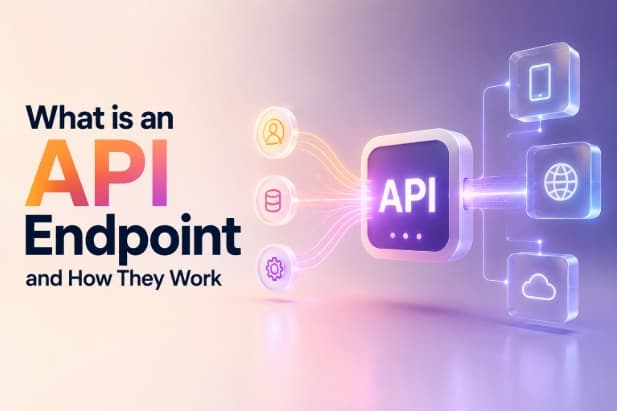
What is an API Endpoint and how they work
Every time you use an AI chatbot, log into an app, check your bank balance, or shop online, your device communicates with a server through an API endpoint. These endpoints act as the entry points where applications exchange data and perform actions.
Understanding API endpoints is one of the first steps toward working with APIs. Whether you're building software, integrating third-party services, or connecting to AI models, knowing how endpoints work makes API documentation easier to understand and integrations much simpler to build.
If you're wondering what an API endpoint is, this guide explains everything you need to know. You'll learn how endpoints process every API request, how they fit into an API structure, how they differ from API routes, and why they are essential to modern applications.
What Is an API Endpoint?
An API endpoint is a unique URL where a client sends an API request to retrieve, create, update, or delete data on a server. Each endpoint represents a specific resource or operation within an API. Think of an API as a collection of services. Every endpoint provides access to one specific service. For example, an e-commerce API might expose separate endpoints for products, customers, and orders.
GET https://api.example.com/products
GET https://api.example.com/customers
POST https://api.example.com/orders
Although these endpoints belong to the same API, each performs a different task. Instead of searching through an entire application, the client sends an API request directly to the endpoint responsible for the required resource.
A Simple Example
Imagine you're using a food delivery application. When you open the restaurant list, the application sends:
GET /restaurants
When you select a restaurant, another API request is sent.
GET /restaurants/52
When you place your order, the application sends:
POST /orders
Each action targets a different endpoint because the server performs a different operation for every request.
Why API Endpoints Matter
Without endpoints, applications would have no organized way to exchange information. Each endpoint provides a clear destination for every API request, making software communication predictable, scalable, and easier to maintain.
Modern applications rely on endpoints to:
- Retrieve customer information
- Process online payments
- Upload files
- Authenticate users
- Generate AI responses
- Search databases
- Synchronize data between applications
- Update account settings
For example, if an AI application needs a response from a language model, it sends an API request to the model's endpoint rather than communicating with the entire service.
Platforms like Tokenware simplify this process even further. Instead of integrating separate endpoints for providers such as OpenAI, Anthropic, Gemini, and Grok, developers send requests through a single unified endpoint. This reduces development time and makes switching between AI providers much easier.
API Endpoint Example
A good way to understand endpoints is to compare several requests.
Retrieve all users
GET https://api.example.com/users
Returns every user.
Retrieve one user
GET https://api.example.com/users/42
Returns information for the user whose ID is 42.
Create a new user
POST https://api.example.com/users
Creates a new user record.
Update a user
PATCH https://api.example.com/users/42
Updates selected information for that user.
Delete a user
DELETE https://api.example.com/users/42
Deletes the user.
Notice that every request uses the same resource (users), but the HTTP method changes what the endpoint does.
How an API Request Works

Understanding what happens after a request is sent helps explain why endpoints are so important. The process typically follows this sequence.
Application
 │
 ▼
API Gateway │ ▼
Authentication
 │
 ▼
API Endpoint
 │
 ▼
Application Logic
 │
 ▼
Database
 │
 ▼
JSON Response
1. The client sends a request
A client such as a website, mobile app, backend service, or AI application sends a request to a specific endpoint.
For example:
GET https://api.example.com/users/42
The request asks the server to return information for the user with the ID 42.
2. The server validates and processes the request
Before processing the request, the server verifies authentication, validates any required parameters, and identifies the endpoint responsible for handling the operation. The endpoint then executes the appropriate business logic, such as retrieving information from a database, creating a new record, or processing a payment. Tokenware follows a similar approach by routing requests through a unified gateway before forwarding them to the selected AI provider. Developers interact with one consistent API structure instead of maintaining separate integrations for every model.
3. The server returns a response
After processing the request, the server sends a response back to the client. Most modern APIs return data in JSON format.
Example:
{
  "id": 42,
  "name": "Grace",
  "email": "grace@example.com"
}
The application uses this information to update the user interface or continue processing.
Understanding API Structure
A well-designed API structure makes endpoints predictable and easier to use. Consider the following endpoint.
https://api.example.com/v1/users/42?include=orders
Each part has a specific purpose.
| Component | Purpose |
|---|---|
https:// | Secure communication protocol |
api.example.com | API server |
/v1/ | API version |
/users/ | Resource |
42 | Resource ID |
include=orders | Query parameter |
When developers follow a consistent API structure, applications become easier to maintain, document, and scale. Good API structure also improves the developer experience because endpoints behave consistently across an entire API.
API Endpoint vs API
 The terms API and API endpoint are often used interchangeably, but they describe different parts of the same system. An API is the complete interface that allows two applications to communicate. An API endpoint is one specific URL within that interface where an API request is sent.
| API | API Endpoint |
|---|---|
| Complete communication interface | One specific URL within the API |
| Contains many endpoints | Handles one resource or operation |
| Provides multiple services | Performs a single task |
| Defines how applications communicate | Processes an individual API request |
For example, an e-commerce API might include endpoints such as:
GET /products
GET /customers
POST /orders
PATCH /inventory
Together, these endpoints make up the complete API.
API Endpoint vs URL
Many beginners assume an endpoint and a URL are the same thing. They are closely related, but not identical. A URL identifies the location of any resource on the internet. An API endpoint is a URL specifically designed for software communication.
For example:
Website URL
Returns an HTML page for users.
API endpoint
https://api.example.com/products
Returns structured data for applications. Every API endpoint is a URL, but millions of URLs are not API endpoints.
API Endpoint vs API Routes
One of the most common areas of confusion involves API routes. Although they work together, they serve different purposes. An endpoint is the public address where clients send requests. An API route is the internal rule inside the application that determines which code should execute after the request arrives.
For example, an Express application might define this route:
app.get("/users/:id", getUser);
When an application sends:
GET /users/42
the route calls the getUser function.
The client only communicates with the endpoint. The application uses API routes internally to determine which controller or function processes the request. Understanding the relationship between endpoints and API routes makes backend frameworks such as Express, FastAPI, Laravel, and Django much easier to understand.
| Request | Action |
|---|---|
GET /products | Retrieve products |
POST /products | Create a product |
PATCH /products/42 | Update product 42 |
DELETE /products/42 | Delete product 42 |
This approach makes APIs easier to understand, document, and maintain.
HTTP Methods Used by API Endpoints
Every API request includes an HTTP method that tells the server what operation to perform.
The most common methods are:
| Method | Purpose | Example |
|---|---|---|
GET | Retrieve data | View products |
POST | Create new data | Create an order |
PUT | Replace an existing resource | Replace a customer profile |
PATCH | Update part of a resource | Change an email address |
DELETE | Remove data | Delete an account |
Using the correct HTTP method creates predictable behavior and follows REST best practices.
Real-World API Endpoint Examples
Almost every digital service exposes endpoints. Here are examples from different industries.
OpenAI
Applications send prompts to an endpoint similar to: POST /v1/chat/completions The server processes the prompt and returns an AI-generated response.
Stripe
When a customer pays online, an application communicates with payment endpoints.
Example:
POST /v1/payment_intents
The endpoint creates a payment intent before the transaction is completed.
GitHub
GitHub provides thousands of endpoints for repositories, users, pull requests, and issues.
Example:
GET /repos/{owner}/{repo}
Returns information about a repository.
Spotify
Music applications retrieve playlists using endpoints such as:
GET /me/playlists
The response includes the user's playlists and metadata.
Weather API
A weather application might request:
GET /forecast?city=Lagos
The server returns weather information for the requested location.
Tokenware
Developers building AI applications often need to integrate multiple model providers. Normally, this means working with different endpoints, authentication methods, and request formats.
Tokenware simplifies this workflow by providing a unified AI Gateway. Instead of maintaining separate integrations for OpenAI, Anthropic, Gemini, Grok, and other providers, developers send a single API request to Tokenware. The platform routes the request to the selected AI model while keeping the request format consistent. This approach reduces development effort and creates a more consistent API structure across AI integrations.
Best Practices for Designing API Endpoints
Well-designed endpoints are easier to use, document, and maintain. Following a few established conventions also improves the experience for developers integrating with your API.
Use Resource-Based URLs
Name endpoints after resources instead of actions.
Good examples:
/users
/orders
/products
Less effective:
/getUsers
/createOrder
/deleteProduct
The HTTP method already describes the action, so the URL should identify the resource.
Keep Naming Consistent
Use the same naming style throughout your API.
For example:
/products
/orders
/customers
Avoid mixing singular and plural resource names or switching between different naming conventions. Consistency makes documentation easier to follow and reduces mistakes during integration.
Version Your API
As APIs evolve, changes can break existing integrations.
Versioning allows developers to introduce improvements without affecting applications already using earlier versions.
Example:
/v1/products
/v2/products
Clients decide when to migrate instead of being forced to update immediately.
Return Consistent Responses
Every endpoint should return responses using the same structure whenever possible.
Example:
{
  "success": true,
  "data": {
    "id": 25,
    "name": "Mechanical Keyboard"
  }
}
A predictable response format makes applications easier to build and reduces parsing errors.
Return meaningful status codes
Examples include:
- 200 OK
- 201 Created
- 400 Bad Request
- 401 Unauthorized
- 404 Not Found
- 500 Internal Server Error
These codes help developers troubleshoot problems quickly.
Secure every endpoint
Protect endpoints using HTTPS, API keys, OAuth, JWT, and rate limiting. If you're using Tokenware, every API request is authenticated before it is routed to the selected AI provider. This helps protect applications while maintaining a consistent integration experience.
Securing API Endpoints
 Security is essential because many endpoints handle customer information, financial transactions, or AI workloads.
The most common security measures include:
| Security Method | Purpose |
|---|---|
HTTPS | Encrypts requests and responses |
API Keys | Identifies the calling application |
OAuth | Grants delegated access |
JWT | Authenticates users |
Rate Limiting | Prevents abuse and excessive requests |
For AI applications, these protections are especially important because every API request consumes compute resources.
Platforms like Tokenware authenticate every incoming request before routing it to the selected AI provider. This gives developers a single, secure integration point while protecting access to supported AI models.
Testing API Endpoints
Testing verifies that an endpoint behaves as expected before it is used in production. It helps developers identify issues with requests, responses, authentication, and error handling early in the development process.
Popular testing tools include:
- Postman for sending and organizing API requests through a graphical interface.
- cURL for testing endpoints directly from the command line.
- Swagger UI for exploring interactive API documentation and executing requests from a browser.
For example, you can use cURL to retrieve a user:
curl https://api.example.com/users/42
Regular testing ensures that endpoints return the expected data, respond with the correct status codes, and continue working after updates.
Conclusion
API endpoints make communication between applications possible. Every API request is sent to an endpoint, making it essential to understand how endpoints, API routes, and API structure work together when building or integrating software.
Whether you're connecting payment services, cloud platforms, or AI models, a clear understanding of API endpoints helps you build more reliable integrations and troubleshoot issues more efficiently. If you're working with multiple AI providers, platforms like Tokenware simplify development by providing a single endpoint for accessing different models through one consistent interface.
Frequently Asked Questions
1. How do path parameters differ from query parameters?
Path parameters identify a specific resource and form part of the URL, such as /users/42. Query parameters provide additional options or filters without changing the resource, such as /users?role=admin&status=active.
2. What is idempotency in an API?
Idempotency means sending the same request multiple times produces the same result. For example, repeated GET requests return the same resource without modifying it, while a properly implemented PUT request updates a resource to the same state regardless of how many times it is sent.
3. Why is versioning important?
Versioning allows developers to introduce new features or changes without breaking existing integrations. Common approaches include URL versioning (/v1/users), header-based versioning, and query parameter versioning.
4. What is the difference between synchronous and asynchronous requests?
A synchronous request waits for the server to complete processing before continuing. An asynchronous request allows the client to continue other tasks while the server processes the request, making it more suitable for long-running operations.
5. How should errors be handled in an API?
Errors should return meaningful HTTP status codes along with a structured response containing an error code, message, and any additional details needed for troubleshooting. This makes debugging faster and improves the developer experience.
6. What makes well-designed API endpoints?
Well-designed API endpoints use consistent naming conventions, standard HTTP methods, proper status codes, versioning, authentication, and predictable response formats. They should also represent resources clearly and remain easy to understand as the API grows.
7. How do rate limits affect API performance?
Rate limiting controls how many requests a client can send within a specific time period. It helps prevent abuse, protects server resources, and ensures fair access for all users while maintaining stable performance.
8. How can I document API endpoints effectively?
Good documentation includes the request URL, supported HTTP methods, authentication requirements, request parameters, example requests, response schemas, status codes, and sample error responses. Standards such as OpenAPI make documentation easier to maintain and integrate with tools like Swagger UI.