
AI Safety vs AI Security: What’s the Difference?
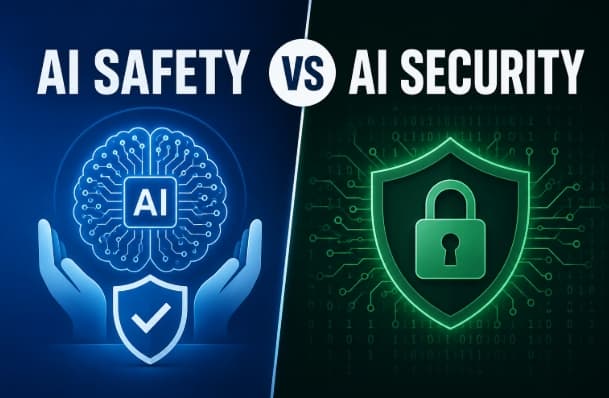
AI Safety and AI security are often used interchangeably, but they address different challenges. AI Safety focuses on ensuring that AI systems behave in ways that are reliable, predictable, and aligned with human expectations. AI security focuses on protecting AI systems, data, and infrastructure from attacks, misuse, and unauthorized access.
As organizations deploy generative AI, machine learning models, and autonomous systems, they must manage issues such as harmful outputs, data breaches, prompt injection attacks, and model manipulation. A system that is secure from attackers can still produce unsafe results, while a system that behaves safely can still contain weaknesses that attackers exploit.
The key difference is simple: AI Safety addresses unintended harm caused by the model’s behavior, while AI security addresses intentional harm caused by malicious actors. Understanding both helps organizations reduce operational risks, identify vulnerabilities early, and deploy AI systems with greater confidence.
What Is AI Safety?
AI Safety refers to the practices, policies, and technical controls that help an AI system behave in a reliable, predictable, and beneficial way. The goal is to reduce the chance that the model produces harmful, misleading, or unintended outcomes.
Examples include a medical chatbot recommending an unsafe treatment, an autonomous vehicle making a dangerous driving decision, or a hiring system producing biased results. These problems can occur even when the system has not been attacked or compromised.
Organizations improve safety through model evaluation, human oversight, guardrails, content filtering, and reinforcement learning from human feedback. They also test models extensively before deployment to identify harmful outputs, inconsistent behavior, and other potential failures.
Because AI Safety focuses on how a model behaves in real-world situations, it is especially important in healthcare, finance, transportation, education, and other high-impact industries where incorrect AI decisions can affect people, operations, and business outcomes.
What Is AI Security?
 AI security focuses on protecting AI systems from malicious activity. The concern is not whether the model behaves correctly on its own, but whether someone can exploit, manipulate, steal, or disrupt the system.
Common AI threats include prompt injection attacks, data poisoning, model extraction, credential theft, and API abuse. These attacks target the infrastructure surrounding the AI model.
AI security focuses on protecting AI systems from malicious activity. The concern is not whether the model behaves correctly on its own, but whether someone can exploit, manipulate, steal, or disrupt the system.
Common AI threats include prompt injection attacks, data poisoning, model extraction, credential theft, and API abuse. These attacks target the infrastructure surrounding the AI model.
To strengthen AI security, organizations implement authentication, encryption, rate limiting, network segmentation, and continuous monitoring. They also conduct adversarial testing to identify AI vulnerabilities before attackers do. As AI becomes integrated into business operations, strong AI security is essential for protecting customer data, intellectual property, and critical services from evolving AI threats.
AI Safety vs AI Security: Key Differences
| Aspect | AI Safety | AI Security |
|---|---|---|
| Primary concern | Unintended harm | Malicious attacks |
| Main question | Will the AI behave safely? | Can someone compromise the AI? |
| Threat source | The AI system itself | External actors |
| Focus | Reliability and alignment | Protection and defense |
| Typical issues | Bias, hallucinations, unsafe decisions | Data theft, model theft, prompt injection |
| Success metric | Safe outputs | Secure systems |
The table highlights why AI Safety and AI security should be managed together. One addresses harmful behavior, while the other addresses hostile actors and system protection.
Common AI Threats in Enterprise Systems
As AI becomes part of everyday business operations, organizations face a wider range of security challenges. Understanding the most common threats helps teams identify weaknesses early and build more resilient AI systems.
The most common AI threats include:
- Prompt injection: Attackers craft malicious prompts to manipulate a model into ignoring instructions or revealing restricted information.
- Data poisoning: Malicious or inaccurate data is introduced during training, causing the model to produce unreliable or biased outputs.
- Model extraction: Attackers repeatedly query a model’s API to recreate or steal a proprietary model.
- Adversarial attacks: Carefully modified inputs cause the model to make incorrect predictions or classifications.
- Supply chain attacks: Vulnerabilities in third-party models, plugins, or datasets compromise the overall AI system.
- API abuse: Unauthorized or excessive API usage leads to data exposure, service disruption, or increased operational costs.
These threats continue to evolve as AI adoption grows. Organizations should combine proactive monitoring, secure development practices, and regular testing to reduce the likelihood of successful attacks.
Understanding AI Vulnerabilities

AI vulnerabilities are weaknesses that attackers or system failures can exploit. They may exist within the model, the training pipeline, the API layer, or the surrounding infrastructure.
Common AI vulnerabilities include weak authentication, exposed API keys, insufficient input validation, unverified training data, and inadequate monitoring. A single exposed credential can provide unauthorized access to an AI service, while poorly validated prompts can enable prompt injection attacks.
Many organizations discover AI vulnerabilities only after deployment, when remediation becomes more expensive and disruptive. Security teams should assess infrastructure, model access controls, data sources, and third-party integrations before a system goes live.
Identifying AI vulnerabilities early reduces operational disruption, compliance exposure, and the likelihood of successful attacks. Regular security assessments, penetration testing, and adversarial evaluations help organizations detect AI vulnerabilities before attackers exploit them.
How Organizations Reduce AI Risks
Reducing AI risks requires a structured approach that combines governance, testing, monitoring, and incident response.
Organizations begin by defining acceptable model behavior and evaluating systems against safety, accuracy, bias, and compliance requirements before deployment. This helps identify potential failures before they affect users.
Red-team exercises play an important role in uncovering hidden AI risks. By simulating adversarial attacks and misuse scenarios, security teams can identify weaknesses that standard testing may miss.
Continuous monitoring helps detect unusual prompts, suspicious access patterns, and harmful outputs in real time. Human oversight remains essential in high-impact sectors such as healthcare, finance, transportation, and public services, where automated decisions can have serious consequences.
Organizations should also establish clear incident response procedures for containment, investigation, and remediation when unsafe behavior or security breaches occur. By combining AI Safety practices with strong AI security controls, businesses significantly reduce long-term AI risks, strengthen resilience against AI threats, and address critical AI vulnerabilities before they become major incidents.
AI Safety Frameworks and Standards
Several industry frameworks help organizations implement AI Safety and AI security consistently.
- NIST AI Risk Management Framework (AI RMF): Provides guidance for identifying, assessing, and managing AI risks throughout the AI lifecycle.
- ISO/IEC 42001: Establishes requirements for AI management systems and supports governance of AI development and deployment.
- EU AI Act: Introduces regulatory obligations for high-risk AI systems, including transparency, human oversight, and risk management requirements.
- OWASP guidance for LLM applications: Addresses common AI vulnerabilities and AI threats associated with large language models.
Using recognized frameworks strengthens both AI Safety and AI security while improving compliance and audit readiness.
AI Safety in High-Risk Industries
High-risk industries place a greater emphasis on AI Safety because errors can directly affect human well-being.
In healthcare, AI Safety helps prevent incorrect diagnoses and unsafe treatment recommendations. In finance, it reduces discriminatory lending decisions and unreliable risk assessments.
Transportation systems rely on AI Safety to ensure autonomous vehicles and traffic management systems behave predictably. Government agencies use AI Safety controls to protect citizens from harmful or unfair automated decisions.
These industries also face significant AI threats and AI vulnerabilities, making strong AI security essential alongside safety controls.
Where AI Safety and AI Security Overlap
Many real-world incidents involve both reliable model behavior and protection against malicious activity. A prompt injection attack is a good example. The incident begins when an attacker manipulates the system, but the impact grows if the model generates harmful or restricted content. The same event therefore affects both the protective controls around the system and the quality of the model’s output.
Data poisoning creates a similar overlap. An attacker compromises the training process, and the resulting model may produce inaccurate, biased, or unsafe results. The original breach occurs during data handling, but the consequences appear later in the model’s behavior.
This connection explains why organizations should not isolate governance, engineering, and cybersecurity efforts. A coordinated approach makes it easier to detect weaknesses early, respond to incidents quickly, and maintain trustworthy operations across the entire lifecycle.
Best Practices for Safe and Secure AI

- Establish clear governance policies before deployment.
- Define acceptable model behavior and operational boundaries.
- Conduct regular evaluations to identify harmful outputs, inconsistent responses, and compliance issues.
- Implement strong access controls to prevent unauthorized use.
- Encrypt sensitive data in storage and during transmission.
- Monitor prompts, outputs, and system activity continuously.
- Perform adversarial testing to uncover hidden weaknesses.
- Maintain audit logs for visibility into system activity and decision-making.
- Train employees on responsible AI development and incident reporting procedures.
- Review and update controls regularly as AI systems evolve.
Together, these measures improve reliability, strengthen resilience against attacks, and help organizations maintain trustworthy AI systems as adoption continues to grow.
Conclusion
AI Safety and AI security address different but complementary challenges. One focuses on ensuring that AI systems produce reliable and beneficial outcomes, while the other focuses on protecting those systems from attacks, misuse, and unauthorized access.
Organizations deploying AI at scale must manage emerging threats, reduce operational risks, and identify weaknesses before they become costly incidents. A model that behaves safely can still be vulnerable to attackers, while a well-protected system can still generate harmful or unreliable results if its behavior is not properly governed.
As AI adoption expands across healthcare, finance, transportation, and enterprise software, businesses that invest in both strong behavioral safeguards and robust security controls will be better positioned to maintain trust, meet regulatory expectations, and deploy AI responsibly over the long term.
Frequently Asked Questions
1. Can prompt injection bypass system instructions?
Yes. If input validation and guardrails are weak, a crafted prompt can override intended behavior.
2. What is a model extraction attack?
An attacker repeatedly queries an API to approximate or reconstruct a proprietary model.
3. How does data poisoning affect a model?
It introduces malicious or misleading data during training, which can distort future outputs.
4. What is adversarial testing?
It is a controlled attempt to break or manipulate a model in order to find weaknesses before deployment.
5. Why are exposed API keys dangerous?
They can allow unauthorized access, misuse of services, and unexpected operational costs.
6. What is red-team testing?
A specialized team simulates real-world attack scenarios to evaluate system resilience.
7. How often should a production model be evaluated?
Regularly after deployment and whenever major data, policy, or model changes occur.
8. What is retrieval-augmented generation (RAG) risk?
Compromised or untrusted retrieved documents can influence the model’s response.
9. Can encryption protect model weights?
Encryption helps protect model files during storage and transmission but should be combined with access controls.
10. What metrics help evaluate model reliability?
Common metrics include accuracy, precision, recall, latency, and consistency across test cases.