
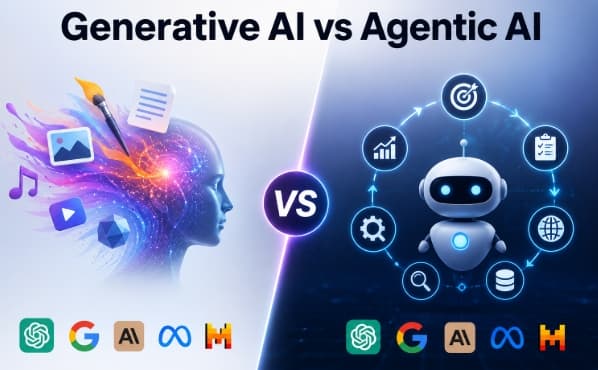
Generative AI vs Agentic AI: What Are the Key Differences?
The conversation around artificial intelligence is changing. Until recently, most AI tools were built to answer questions or generate content. Today, a new generation of AI systems is emerging, one that can plan tasks, make decisions, use external tools, and work toward a goal with limited human input. As a result, more businesses are comparing Generative AI vs Agentic AI to understand which approach best fits their needs.
While both technologies are powered by large language models, they serve different purposes. Generative AI creates content such as text, images, and code. Agentic AI goes a step further by enabling AI agents to execute tasks, coordinate AI workflows, and interact with other systems through AI orchestration.
What Is Generative AI?
Generative AI is a type of artificial intelligence that creates original content from a user's prompt. Instead of retrieving existing information like a search engine, it produces text, images, audio, video, or code by identifying patterns learned from large datasets. This ability has transformed how people create content, solve problems, and automate everyday tasks.
Most modern AI tools are powered by large language models(LLMs) trained on billions of words from books, websites, and other publicly available sources. When you enter a prompt, the model analyzes the context and predicts the most likely sequence of tokens to generate a relevant response. Because each output is created dynamically, similar prompts often produce different results.
Common applications include:
- Writing articles, emails, and reports
- Creating marketing copy
- Generating software code
- Summarizing documents
- Translating languages
- Producing images from text prompts
Popular examples include ChatGPT, Claude, Gemini, Midjourney, and Stable Diffusion.
While these tools excel at creating content, they do not independently plan tasks or make decisions. Every response depends on user input, making them ideal for writing, design, research, and coding. Managing complex AI workflows or coordinating actions across multiple systems typically requires AI agents and AI orchestration, which are covered later in this guide.
How It Works
The process begins with a prompt. The model analyzes the request using patterns learned during training, predicts the next most likely tokens, and generates a response in real time. Unlike traditional software, it does not retrieve a stored answer. Instead, it creates new content for each request.
This flexibility has made the technology a core component of enterprise AI, helping organizations improve productivity, streamline content creation, and support employees across a wide range of business functions.
What Is Agentic AI?
Agentic AI is a type of artificial intelligence designed to achieve goals rather than simply respond to prompts. An AI agent can plan tasks, make decisions, use external tools, and adapt its actions based on new information. Instead of waiting for instructions after every step, it works toward completing an objective with minimal human input.
Many agentic systems are powered by large language models, but they combine them with memory, planning, and AI orchestration to execute multi-step tasks. This makes them well suited for automating AI workflows across different applications and business systems. Common capabilities include:
- Goal planning
- Task prioritization
- Tool integration
- Memory
- Decision making
- Continuous evaluation
How Agentic AI Works
The process starts with a goal. The system breaks that goal into smaller tasks, selects the right tools, completes each action, evaluates the results, and repeats the process until the objective is achieved.
For example, an AI sales assistant could gather customer information from a CRM, generate a personalized proposal, schedule a follow-up meeting, and notify the sales team without requiring a separate prompt for every task.
These capabilities make agentic systems an important part of enterprise AI, where businesses use autonomous systems to streamline operations and reduce repetitive manual work.
Generative AI vs Agentic AI: Key Differences

Although both technologies use advanced machine learning techniques, they serve different purposes.
The simplest distinction is this:
- Generative AI creates content.
- Agentic AI completes objectives.
The following comparison highlights their core differences.
| Feature | Generative AI | Agentic AI |
|---|---|---|
| Primary purpose | Generates content | Completes goals and tasks |
| User input | Individual prompts | High-level objectives |
| Autonomy | Low | High |
| Planning | No long-term planning | Multi-step planning |
| Memory | Usually limited to conversations | Persistent task memory |
| Tool usage | Limited | Uses multiple external tools |
| Decision making | Responds to prompts | Chooses actions based on goals |
| Human involvement | Frequent | Reduced after task assignment |
| Best suited for | Content creation | Process automation |
These differences explain why organizations are increasingly using both technologies together rather than treating them as competing solutions.
When Should You Use Generative AI?

Generative AI delivers the most value when the primary goal is to create or transform content. It speeds up tasks that would otherwise require significant manual effort while allowing users to review and refine the output before publishing or sharing.
Common use cases include:
| Use Case | Why Generative AI Fits |
|---|---|
| Blog writing | Produces first drafts and outlines quickly |
| Marketing content | Creates ad copy, social posts, and email campaigns |
| Customer communication | Drafts responses for support teams |
| Software development | Generates code snippets and documentation |
| Research summaries | Condenses lengthy reports into key points |
| Image creation | Produces visuals from text prompts |
For example, a marketing team launching a new product might use generative AI to create product descriptions, email campaigns, landing page copy, and social media posts. Human editors then review the content for accuracy, tone, and brand consistency before publication.
This approach improves productivity without replacing human judgment.
When Should You Use Agentic AI?
Agentic AI is designed for situations where completing a task involves multiple decisions or interactions across different systems. Instead of assisting with one prompt at a time, it manages an entire process from start to finish.
Typical applications include:
| Use Case | Why Agentic AI Fits |
|---|---|
| Customer service | Resolves requests by accessing internal systems |
| Market research | Collects and analyzes information from multiple sources |
| Sales operations | Qualifies leads and schedules meetings |
| IT support | Diagnoses issues and initiates fixes |
| Software testing | Runs tests, identifies bugs, and reports findings |
| Business operations | Automates repetitive business processes |
Imagine a company receives hundreds of support tickets every day. Instead of asking an employee to review each request, an AI agent categorizes tickets, retrieves customer records, checks previous conversations, suggests solutions, and escalates only the cases requiring human attention. This reduces response times while allowing employees to focus on more complex issues.
Advantages and Limitations
Neither technology is universally better. Each excels in different situations.
Generative AI
Advantages
- Produces content quickly.
- Supports a wide range of creative tasks.
- Improves productivity across writing, coding, and design.
- Requires minimal setup for most users.
Limitations
- Does not independently complete long, multi-step objectives.
- Requires user guidance for every new task.
- Responses depend heavily on prompt quality.
- May generate inaccurate or outdated information if outputs are not reviewed.
Agentic AI
Advantages
- Automates complex processes.
- Plans and adapts while working toward a goal.
- Connects multiple applications and services.
- Reduces manual intervention in repetitive tasks.
Limitations
- More difficult to design and deploy.
- Requires careful monitoring and governance.
- Performance depends on the quality of connected tools and data.
- Increased autonomy introduces additional security and compliance considerations.
For many organizations, the most effective solution combines both technologies instead of replacing one with the other.
Can Generative AI and Agentic AI Work Together?
Yes. In fact, this is how many modern AI systems operate. Generative AI provides the intelligence needed to understand language and create content. Agentic AI coordinates actions, makes decisions, and manages execution.
Think of their relationship this way:
- Generative AI creates.
- Agentic AI coordinates.
Consider a customer support assistant. A customer submits a question about a delayed shipment. Instead of simply generating a generic response, an agentic system follows a sequence of actions:
- Reviews the customer's order history.
- Checks shipping information.
- Determines the delivery status.
- Requests updated tracking information if needed.
- Uses generative AI to write a personalized response.
- Sends the email and records the interaction.
The customer experiences one seamless conversation, even though multiple systems worked together behind the scenes. This combination is becoming increasingly common in enterprise AI, where businesses want automation without sacrificing natural communication.
How Businesses Use Both Together

Organizations across different industries are adopting both technologies to improve efficiency while maintaining human oversight.
Marketing
Marketing teams use generative AI to create campaign content while agentic systems schedule posts, monitor performance, and recommend adjustments based on results.
Customer Support
Support platforms generate personalized responses while autonomous systems retrieve account details, verify customer identity, update records, and resolve routine requests.
Software Development
Developers use generative AI to write code and documentation. Agentic systems extend this process by testing applications, identifying bugs, running deployment checks, and tracking progress across development environments.
Finance
Financial institutions use AI to summarize reports and generate client communications while autonomous systems review transactions, flag unusual activity, and coordinate approval processes.
Human Resources
Recruitment teams use generative AI to create job descriptions and interview questions. Agentic systems screen applications, schedule interviews, collect feedback, and maintain hiring pipelines.
In each example, content generation supports decision-making, while intelligent automation handles execution. This combination creates more efficient AI workflows without requiring employees to manage every individual step manually.
How Businesses Use Both Together
Many businesses combine generative and agentic AI to improve productivity and automate routine work. For example, generative AI creates emails, reports, or marketing content, while AI agents execute tasks such as retrieving data, updating records, or coordinating AI workflows across different systems.
As adoption grows, managing multiple AI models becomes more complex. Platforms like Tokenware simplify this by providing a unified API for AI orchestration, allowing developers to access models from different providers through a single integration. This makes it easier to build scalable enterprise AI applications that combine content generation with autonomous task execution.
Choosing Between Generative AI and Agentic AI
The right choice depends on what you want AI to accomplish. If your goal is to generate content, answer questions, or assist with creative work, generative AI is often the better option. If your goal is to automate business processes, coordinate multiple systems, or complete tasks with minimal supervision, agentic AI is the stronger fit.
The table below provides a quick way to evaluate common scenarios.
| If you need to... | Best Choice | Why |
|---|---|---|
| Write articles, emails, or reports | Generative AI | Creates high-quality content from prompts |
| Brainstorm ideas | Generative AI | Produces multiple creative suggestions quickly |
| Generate software code | Generative AI | Assists developers with coding and documentation |
| Automate repetitive business tasks | Agentic AI | Executes tasks across multiple systems |
| Manage customer support processes | Agentic AI | Plans actions and resolves requests efficiently |
| Coordinate business operations | Agentic AI | Connects tools and completes multi-step objectives |
| Research information and prepare reports | Combination of both | One gathers information while the other generates the final report |
| Build intelligent business assistants | Combination of both | Combines content generation with autonomous execution |
For many organizations, the decision is not about choosing one technology over the other. Instead, it involves identifying where each provides the greatest value within existing business processes.
For example, a content marketing team may rely primarily on generative AI to produce articles and campaign copy. Meanwhile, the operations team uses agentic systems to assign tasks, monitor approvals, and distribute content across multiple channels.
As AI capabilities continue to advance, hybrid systems are becoming the preferred approach because they combine creativity with automation.
Will Agentic AI Replace Generative AI?
No. Agentic AI is unlikely to replace generative AI because the two technologies serve different purposes.
Many AI agents rely on large language models to understand requests, generate responses, and communicate naturally with users. Agentic AI adds planning, reasoning, memory, and AI orchestration, allowing these systems to complete multi-step tasks instead of simply generating content.
For example, a travel assistant might search for flights, compare hotel prices, build an itinerary, and send a confirmation email. The agent manages the workflow, while the language model generates the written content.
Rather than competing, the two technologies work together. As enterprise AI continues to evolve, organizations are increasingly combining content generation with autonomous execution to build more capable and efficient AI solutions.
Conclusion
The choice between Generative AI vs Agentic AI is not about which technology is better, but which one best fits your needs. Generative AI is designed to create content, while AI agents use planning, reasoning, and AI orchestration to complete tasks and automate complex AI workflows.
For many organizations, the greatest value comes from combining both approaches. Generative models provide the intelligence to create and communicate, while agentic systems execute actions across business processes. As enterprise AI continues to evolve, understanding how these technologies work together will help businesses build smarter, more efficient AI solutions.
Frequently Asked Questions
1. What is the difference between Generative AI and Agentic AI?
The main difference is that Generative AI creates content from prompts, while Agentic AI uses AI agents to plan, make decisions, and complete multi-step tasks.
2. Is Agentic AI better than Generative AI?
Neither is better. In Generative AI vs Agentic AI, the right choice depends on your goal. One creates content, while the other automates tasks and workflows.
3. Does Agentic AI use large language models?
Yes. Most agentic systems rely on large language models for reasoning and communication, then combine them with planning, memory, and external tools.
4. Is ChatGPT an AI agent?
No. ChatGPT is primarily a generative AI model. It becomes part of an AI agents when integrated with planning, memory, and tool execution.
5. What are AI agents?
AI agents are autonomous systems that plan tasks, use external tools, make decisions, and work toward a defined goal with limited human input.
6. Is Agentic AI the future of enterprise AI?
Agentic AI is expected to play a major role in enterprise AI, especially for automating business processes and improving operational efficiency.
7. How does Agentic AI improve AI workflows?
It automates repetitive tasks, coordinates multiple applications, evaluates results, and adapts actions to achieve a specific objective.
8. Will Agentic AI replace Generative AI?
No. In the debate around Generative AI vs Agentic AI, both technologies complement each other. Most modern AI solutions combine content generation with autonomous task execution.
9. Can Generative AI perform AI workflows?
On its own, no. It responds to prompts, while AI workflows usually require an agentic system to coordinate multiple actions.
10. What is AI orchestration?
AI orchestration is the process of coordinating AI models, tools, data sources, and applications so they work together to complete a task